Home > Articles posted by:Pasquale Francesco Romano ( > Page 15)

Play with optic

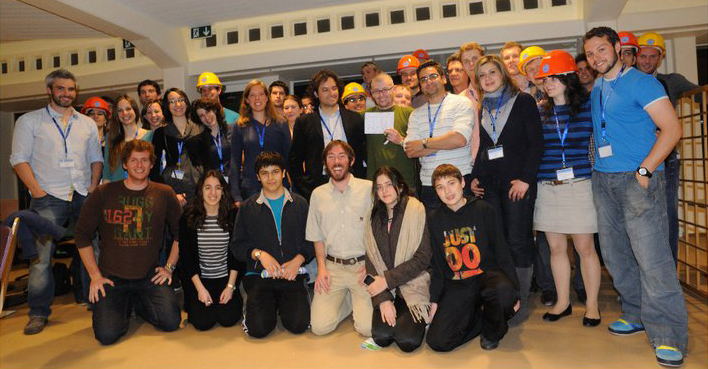
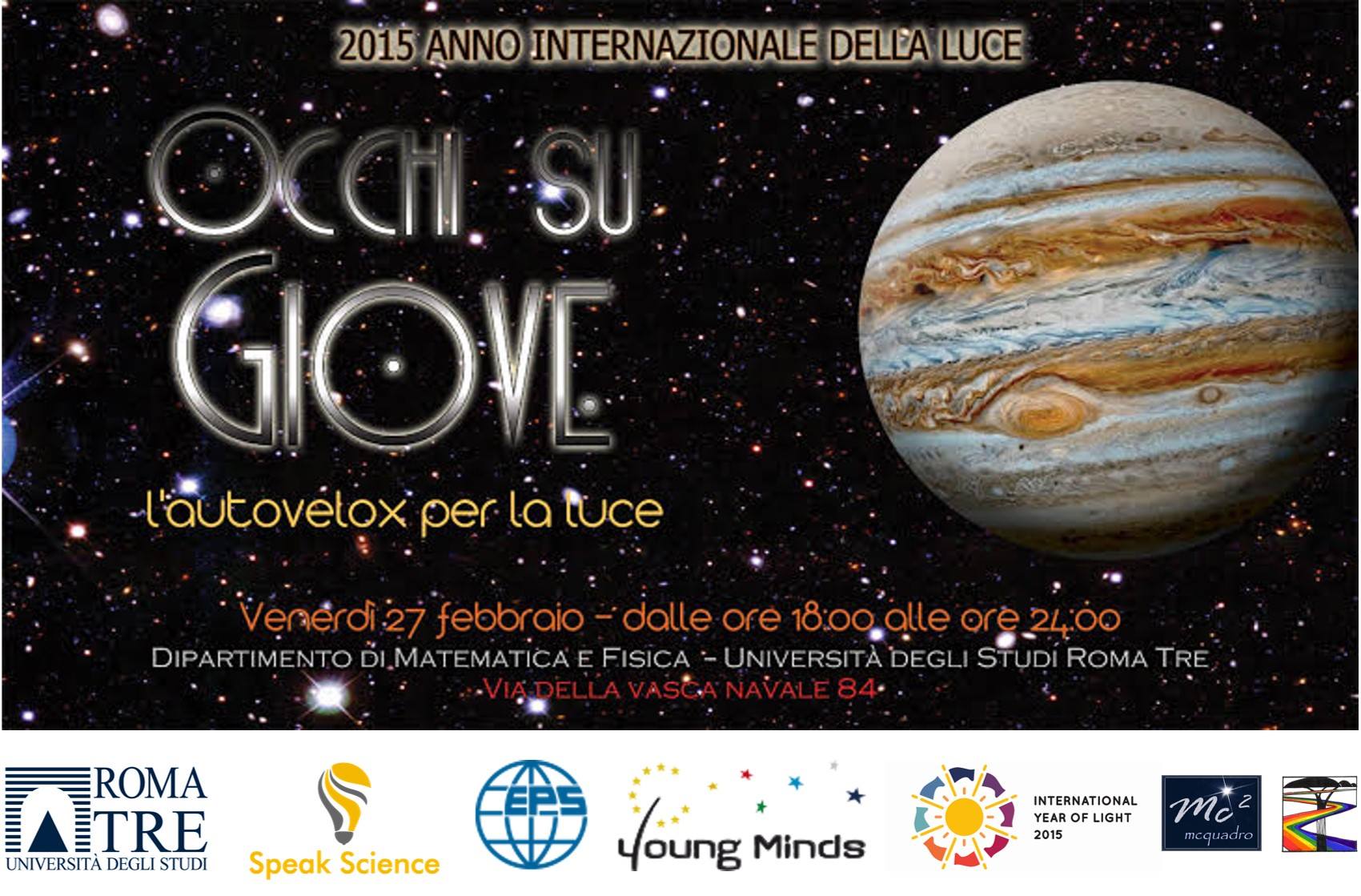
Rome_IYL__01On February 27th,at Roma Tre Mathematics and Physics Department, was performed the event “Occhi su Giove: l’autovelox per la luce”. About 600 persons took part at the evening.
During the event it was possible to observe with telescopes of the Department and to took part at the ‘Play with optics’ experiments.
Our experiments concerned arguments studied during the degree course and expanded for personal curiosity. Experiments concepts were:

  1. OPTICS LAWS: The purpose of the activity was to provide an opportunity to discover the optics (geometrical and physical) by means of hands-on labs. To explain these phenomena we used:
    • laser pointers and mirrors , to show refraction and reflection laws of light in water and in other materials;
    • different torches to show diffusion in a medium and to answer questions like ‘Why is the sky blue?’;
    • bottles filled with water to produce waveguides;
    • 3D cinema glasses and a LCD monitor, whose screen was used as a polarizing filter, in order to explain the polarization of light;
    • Slits, laser and participants’ hair were used to talk about the diffraction of light.
  2. THE EYE AND THE 3D VISION: The experiment was focused on eye’s functionality and was divided into three steps: the anatomical components of a healthy eye, how these components works together, and why, if one eye works perfectly alone, we have two of them?
    In this regard, a demonstration on how our brains are able to make us understand the three-dimensions, using a stereoscope, was given.
    Moreover was explained the concept of the cinema 3D vision, with practical demonstration of the three-dimensional view of a siderite through anaglyph glasses.
  3. GRAVITATIONAL LENSES, MASS THAT DEFLECTS LIGHT: The idea at the base of the experiments was to show that the general relativity’s topics aren’t so far from reality. In fact, many theory’s arguments have a practical application like the gravitational lenses, which are used for astrophysics’ investigations. To do that, minor experiments have been used. Some of that were: a sheet bended by a ball to simulate the warped space-time and a mirror that shows how candle’s light could be reflected or distorted, as the gravitational lenses do.
  4. AUTO-GRAVITING WATER: The goal of the experiment is to obtain an optical effect that gives various perception of water drops: flowing downward in slow motion, suspended in the air, flowing upward. To achieve this goal, two tools have been used: a subwoofer and a strobe light. The water flowed in a little tube attached to the subwoofer that made it oscillate, and when the water was spilled out, it was enlightened by the strobe light at different frequencies. The demonstration of these three optical effects have been made possible by using specific frequencies of the strobe light.

[nggallery id=12]
First contact with the university

schoolsDays 11, 14, 15 and 21 of January we offered to students in last high school year several seminars. Firstly, we started the sessions with the presentation of our group GOC and our ongoing and future activities. Secondly, we explained why 2015 is the International Year of Light and the importance of light for the life. After we showed them some light properties, they made a practical activity related with diffraction to guess if they have a DVD or a CD.
Some month later, on Thursday 21st of May took place an activity developed by UJI called FIRUJICIÈNCIA where students from high school and university had the chance to see science demonstrations in different stands. There we showed them some characteristics of light and its application.
We explained polarization by using two polarizers and allowing the students to cross them or to move them freely. We made a photoelasticity demonstration, with two crossed polarizers, we told them to add a transparent medium between both and they could see the effect of the material on light. They could also see refraction and reflection, with a glass of water and a coin we explained them the phenomenon of the total internal reflection and the critical angle. We cloaked the coin while it was under the glass, in air, and show them how depending on the angle of observation you can see it or not. Diffraction demonstration were also developed, we used diffraction gratings and lasers of different wavelength to make clear the dependence of the angle of the diffraction orders with that parameter. Besides, with red, blue and green sources we generated white light to show the spectral content of white light and to explain the importance of the 2014 Nobel Prize in Physics in order to have white light sources with LED illumination. We had a model of the human eye and lenses to simulate image formation and to let them see the effect of myopia and hyperopia and how to correct them using lenses. Finally, outside the building where FIRUJICIÈNCIA took place, we brought a telescope in order to make an observation of the sun.
While doing all the activities, we also told the students why 2015 is International Year of Light and why is light so important in our daily life. We informed them about our group, GOC, and also explained about future activities.

Debrecen YM BAA 2014

coming-soonLorem ipsum dolor sit amet, consectetur adipiscing elit. Curabitur efficitur hendrerit enim sed viverra. Vivamus vestibulum egestas consectetur. Nullam quis hendrerit turpis. Ut commodo quis urna at molestie. Curabitur luctus tortor in turpis commodo pellentesque. Cras aliquet leo metus, eget luctus lectus condimentum vitae. Morbi mattis diam eu tellus luctus, sit amet pulvinar tortor porttitor. Integer vulputate nulla ultrices orci facilisis posuere. Quisque tristique lacus eget risus sodales consequat. Vestibulum volutpat dui vitae sapien rutrum, eget consectetur dui commodo. Vestibulum ante ipsum primis in faucibus orci luctus et ultrices posuere cubilia Curae;

In eu blandit leo, eu semper mi. Sed ornare, metus vel facilisis molestie, arcu neque posuere turpis, sit amet convallis sem massa nec velit. Vivamus in imperdiet mauris. Nullam tristique viverra massa sit amet convallis. Fusce id ipsum id odio interdum tincidunt a in erat. Nunc nec viverra ligula. Mauris ac velit id tortor condimentum cursus vel eu ante. Interdum et malesuada fames ac ante ipsum primis in faucibus.

3rd YM meeting 2014

3rd Young Minds Leadership Meeting Paris

The 3rd Leadership Meetingtook place from Friday 6th to Saturday 7th June, 2014, at the University Pierre et Marie Curie in Paris (France).
Here there are the meeting presentations:

* Video presented by the Naples Section

Visit to the Planetarium

The Messina Young Minds Section, thanks to the financial support of the European Physical Society organized a special visit at the Planetarium Pythagoras in Reggio Calabria, Italy. The Planetarium Pythagoras has one of the most remarkable external geodes in Europe.
Astronomy is one of the oldest sciences and astronomical phenomena have always had a great influence on human life. Unfortunately, observation of constellations is not possible, due for example to light pollution from city lights, or cloudy weather conditions. This is not the case at the Planetarium, which reproduces almost all astronomical phenomena that can be observed at day and at night, at any latitude and at high speed. It is also possible to combine celestial motions to achieve particular effects such as the starry sky observed from the moon or from a space station.

The guided tour was followed by a solar observation through a telescope equipped with a special filter, which allowed participants to observe sunspots, visible as dark circles on the photosphere of the Sun, and solar flares, evidenced by sudden brightening observed over the Sun’s surface. A lecture on optical properties of interstellar grains completed the visit and was presented by Dr. Antonella Iatì, a researcher of the Institute for chemical and physical processes of the Italian National Research Council [IPCF-CNR] in Messina.

This event was addressed to bachelor and master students of the University of Messina. The visit at the planetarium is a simple and effective way of approaching astrophysics. The aim of EPS YM Section of Messina with this visit was to promote new scientific interests and trying on different experiments available at the Planetarium.

MPL Laboratory Visit

The students of the Erlangen Section visited the Max Planck Institute for the Science of Light (MPL) Laboratory.
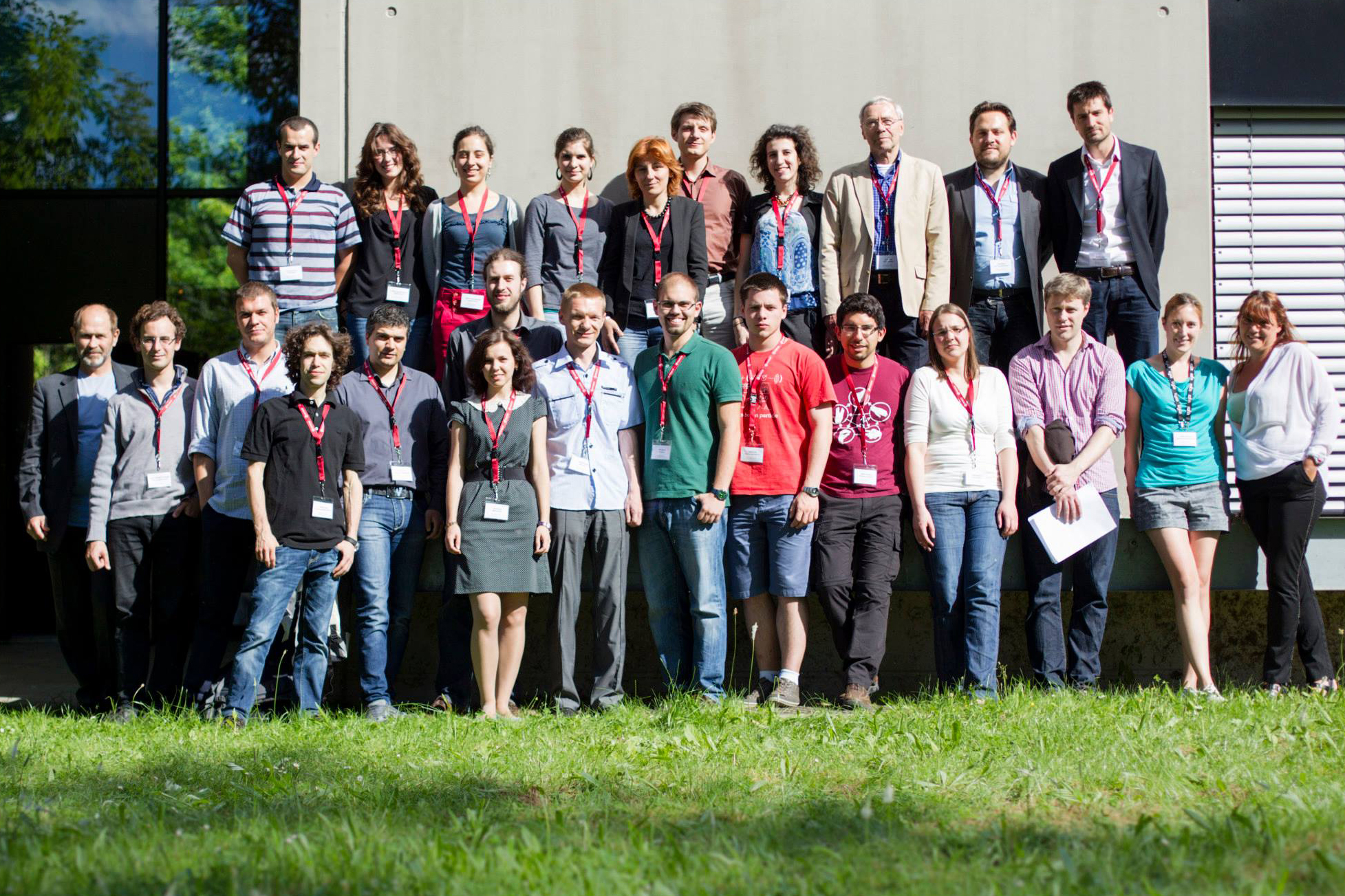
The second Autumn Academy at the Max Planck Institute for the Science of Light took place from 30 September to 2 October 2013. The aim of this two-and-a-half day event was to introduce Bachelor and Master students to the fast moving field of optical sciences including topics such as quantum information processing, meta-materials, nano-optics, photonic crystal fibres, nonlinear optics, imaging and sensing. The response was excellent. From more than 70 applications, the EPS Young Minds section of Erlangen, Germany selected 26 students and invited them to Erlangen for a packed schedule.

The participants received an overview over the wide range of research fields covered by the Max Planck Institute for the Science of Light [MPL] at the poster session that was organised on the first evening.

In the course of the Academy, the participants attended several lectures given both by the Institute’s directors Prof. Gerd Leuchs, Prof. Vahid Sandoghdar and Prof. Philip Russell, by PhD students and group leaders from the MPL and also by the invited lecturers Prof. Florian Marquardt (Friedrich-Alexander-Universität Erlangen-Nürnberg), Prof. Cornelia Denz (University of Münster) and Dr. Jonathan Matthews (University of Bristol). The lectures addressed a wide variety of topics ranging from photonic crystal fibres over nano – and biophotonics to optomechanics to name only a few of them.

Between the lectures several laboratory tours were offered, that allowed the participants to learn about the actual experimental implementations of the research presented in the lectures.

Moscow YM BAA 2013

coming-soonLorem ipsum dolor sit amet, consectetur adipiscing elit. Curabitur efficitur hendrerit enim sed viverra. Vivamus vestibulum egestas consectetur. Nullam quis hendrerit turpis. Ut commodo quis urna at molestie. Curabitur luctus tortor in turpis commodo pellentesque. Cras aliquet leo metus, eget luctus lectus condimentum vitae. Morbi mattis diam eu tellus luctus, sit amet pulvinar tortor porttitor. Integer vulputate nulla ultrices orci facilisis posuere. Quisque tristique lacus eget risus sodales consequat. Vestibulum volutpat dui vitae sapien rutrum, eget consectetur dui commodo. Vestibulum ante ipsum primis in faucibus orci luctus et ultrices posuere cubilia Curae;

In eu blandit leo, eu semper mi. Sed ornare, metus vel facilisis molestie, arcu neque posuere turpis, sit amet convallis sem massa nec velit. Vivamus in imperdiet mauris. Nullam tristique viverra massa sit amet convallis. Fusce id ipsum id odio interdum tincidunt a in erat. Nunc nec viverra ligula. Mauris ac velit id tortor condimentum cursus vel eu ante. Interdum et malesuada fames ac ante ipsum primis in faucibus.

2nd YM meeting 2013

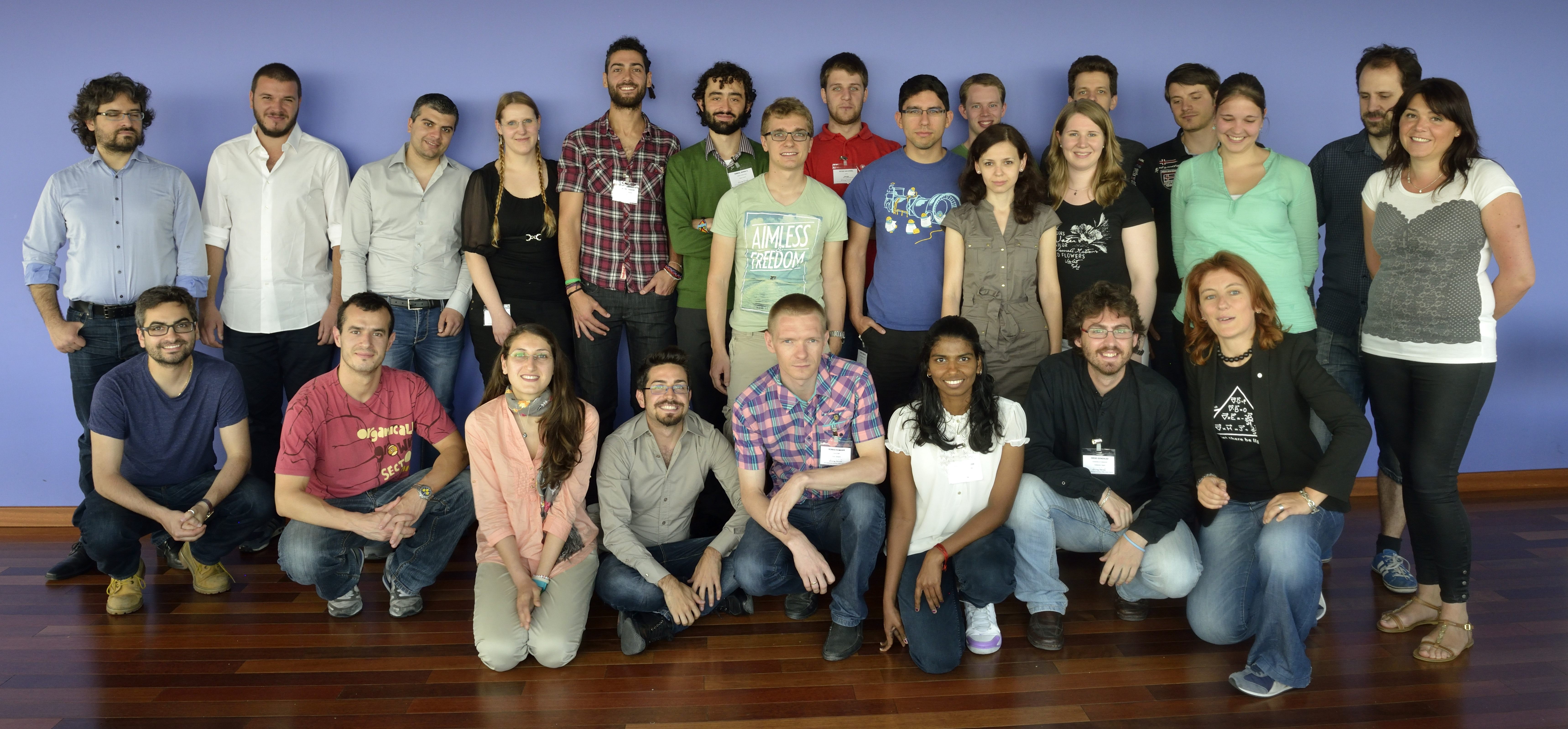
2nd YM MeetingThe 2nd Young Minds Leadership Meeting was held at the EPS Headquarters in Mulhouse (France) on 21-22 June 2013.

Young scientists had the opportunity to hear three eminent speakers. Professor Jo Hermans, from Leiden University (the Netherlands), was invited to give a talk about “Physics in our daily life”. The EPS President John Dudley gave a talk on “Surviving in Science: what they don’t tell you about careers in research”, with simple and practical advice to help early-career researchers to build a long-term career. And J.A. Hutchison, from the University of Strasbourg (France), introduced his scientific studies on “Hybrid Light-Molecule States”.

Here you can find the meeting material:

Science Festival at Bauman Moscow State Technical University

The Festival of Science is the day when the Bauman Moscow State Technical University [BMSTU] opens it doors to numerous curious visitors and welcomes school children, high school graduates, and first-year university students.

BMSTU organised its second Festival of Science at the end of 2012. Every department of the university displayed information describing the research and education in science. Participants could also attend a variety of master classes, lectures, seminars and reports on different scientific topics, presented by senior students, postgraduates and professors.

Members of EPS Young Minds of the BMSTU Section [BMSTU EPS YM Section] presented optics demonstrations and laser games for school children. Vladimir Lazarev, past-President of BMSTU EPS YM Section organised an excursion to modern Scientific-Educational Center “Photonics and IR-techniques”. He also made a presentation on “Passion for Precision: Pursuing the Optical Frequency Standard!”.

The EPS Young Minds found the experience extremely rewarding, exciting, and instructive. The Young Minds team explained to those interested in optics and lasers, how laser works, why the sun light is a mix of all colours of the rainbow, how to produce holograms and interference patterns, how to analyse them, etc. The YM were impressed by the interest they raised around their stand, with many questions by school students of all ages as well as their parents.

“Hit the target” game, laser chess and diffractive glasses were the most attractive and popular exhibits for the visitors.

According to the BMSTU Young Minds opinion, the Festival was very useful and instructive for university entrants, who are considering their future studies.