
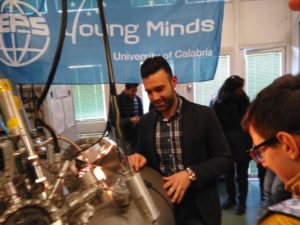
 This activity has comprised both visits of students to University of Calabria, Department of Physics and, moreover, visits of members of the YM section to secondary schools.
Concerning the visits to University of Calabria, students have been involved in simple demonstration of Raman spectroscopy and diffraction experiments with electrons and X-rays. In particular, students have understood how it is possible to recognize the different atomic components in an unknown material. Moreover, they have been introduced into crystallography with simple and funny demonstrations.
The visit to the Department of Physics has been organized thanks to the crucial support of local municipalities, that have kindly shared school buses to transport students to University of Calabria in Arcavacata di Rende (CS).
The visit to University of Calabria has been an occasion to give students the first contact with University and to explain them research at our Department of Physics with simple words.
We have shown them some prototypes of devices fabricated at our Department.
As regards the simple experiments carried out directly at secondary schools, we have tried to simplify as more as possible the concepts in Physics.
As an example, we have provided a direct demonstration of the Archimedes’ principle, with very simple equipment. We have tried to demonstrate that it works on both gaseous and liquid environments, by changing our experimental setup.
We have emphasized the importance of Archimedes’ principle with many examples from our daily lives. We have also stimulated the students to imagine a world where the Archimedes’ principle could not exist.
Moreover, we have built a lemon battery, with the direct participation of students. The goal of making a lemon battery is turning chemical energy into electrical energy, creating enough electricity to power a small LED light or a watch.
Students have experienced and successively realized (with the help of a short and simple explanation) that the source of electric energy in this demonstration is the combination of copper and zinc strips in the citric acid of the lemon.
We have used a multimeter to measure the voltage with one lemon and then again as we added more lemons.
Finally, it is worth mentioning that, throughout the entire duration of the activity, we have discussed with interested students about the various possibilities of carriers in Physics.
We thank the teachers of secondary schools for their kind collaboration.
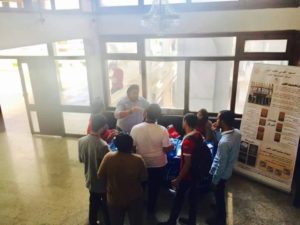 Faculty of Engineering, Cairo University, organizes Annual Job Forum to connect between the faculty student and the Market. EPS CYMS joined the event titled “Biomedical Engineering Careers in the Market” that was held in the conference room of the faculty of Engineering, Cairo University, May 2016 with an attendance of more than 250 students of biomedical engineering from all over Egypt.
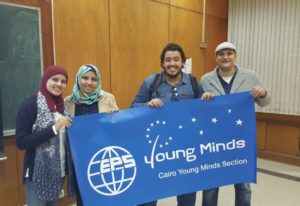 Since it’s an essential knowledge for students who work in one research group, also for us the section members, the day started with a speech about (How to work in a team). The main idea was connecting Science with industries by calling one of related industrial companies in field of optics; Scope Optics Company. Its owner and representative, Dr. M. Abd Elazeem was invited to give a speech and he responded pleasantly. The last seminar was given by Lecturer Yusuf and he is also the section treasurer talking about his work which helps central retinal impairment patients to get the overall visual scene.
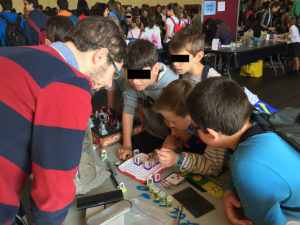 In order to explain some optical phenomena as the reflexion, the refraction, diffraction, the scattering, the absorption and the emission of the light we made an OPTICAL WORKSHOP. In these workshops, we visited schools of different academic levels and we did easy and fun experiments to prove to children and to young people that the science is closer to them. We tried to show them that the science is important in our daily life and that everybody can study science. We usually participate in workshops organized by the University Jaume I. In this year, we participated in the following University’s workshops: 1) “Practica a l’UJI”, 2) “FIRUJICIENCIA 2017”, 3) “Colònies Cientìfiques a L’UJI 2017” and 4) “Connect amb la Ciència de la Universitat Jaume I”. It should be noted that our activities were successful, considering that were attended more than 500 pupils. On the other hand, we can say that in the most cases, the optical workshops have become the first contact of society with the science and with our university. Finally, we believe that these workshops help us to promote our outreach activities and the University Jaume I. Moreover, we have shown to the children and teenagers that to study science can be a good option.
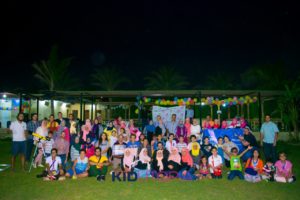 EPS Cairo young minds section contributed to an inspiring event for innovative kids called “Kidutopia”. About fifty kids (from five to sixteen years old) attended this event which is the first event that combines sciences, sports and educational consultations for kids in Egypt. This event had many non-governmental organizations that cooperated with us to give these kids an outreaching in different activities. The YM Cairo section organized and implemented simple experiments relating to various motivating physical phenomenon through enjoyable activates. These experiments included optical illusion, water lens and light refraction in addition to some simple optical activities using a laser kit game. This event had a positive impact on the kids through the participation of the children in performing these experiments. Moreover, this event was very exciting to the section members as it served an extremely important part of the community: Kids
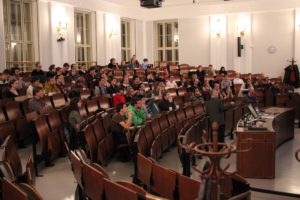 The Students Meeting at the Start of the Semester took place for the fourth time and is beginning to have the status of an established event at the Faculty of Nuclear Sciences and Physical Engineering (FNSPE). This was mirrored by the high attendance of almost 70 people which increased again, compared to the previous semester. As usual, we invited a high-profile speaker in the Czech Republic to give a talk at our university. This time, because of the recent Nobel Prize in the field, we invited Prof. Jiri Podolsky from Charles University to speak about gravitational waves which is the main topic of his research.
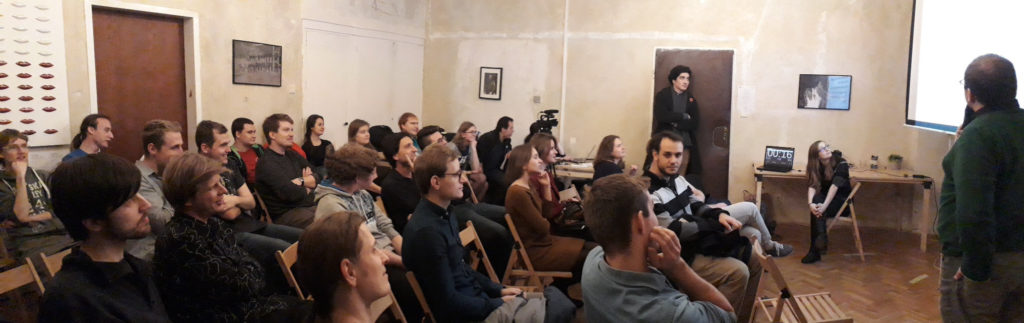 During the winter semester of 2017, a follow-up of the previous semester’s Physics Café was organised as one of the Prague EPS Young Minds events. This time, the aim of the Physics Café project was to further enhance the achievements gained during the first volume of Physics Café i.e. to provide a platform for informal meetings of university students and (senior) scientists and people from academia, with a strong emphasis on informality, and to promote physics and physics related scientific fields among the students.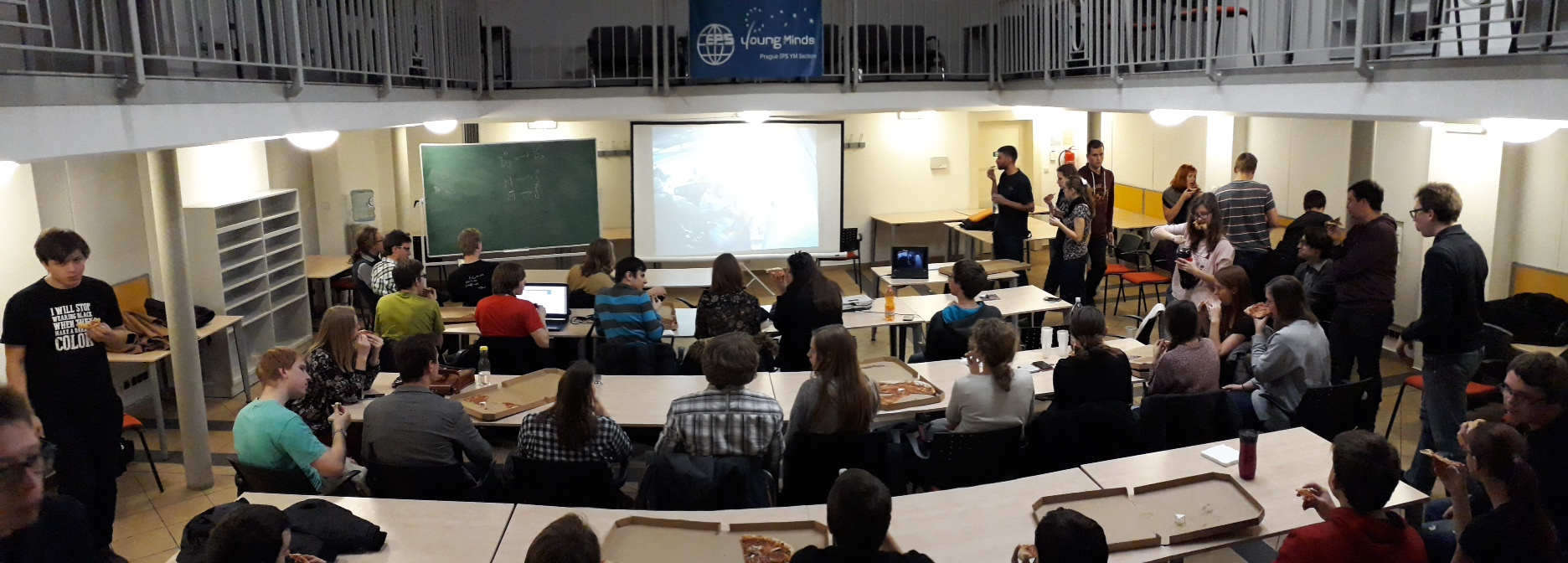
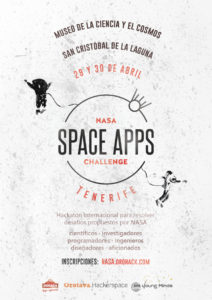 Since its inception in 2012, the International Space Apps Challenge, a part of NASA’s Earth Science Division, has become the world’s largest global hackathon, engaging thousands of citizens each year across the globe to work with NASA in building innovative solutions challenges we face on Earth and in space using open source data. Space Apps inspires local innovation communities in cities across six continents to convene, ideate and build. Diverse and collaborative teams of technologists, scientists, designers, entrepreneurs, and others work together in a 48-hour sprint to develop answers to some of the most pressing challenges facing planet Earth using NASA data. Over 25,000 citizens from 69 countries and in 187 cities around the world participated in the 2017 International Space Apps Challenge.