
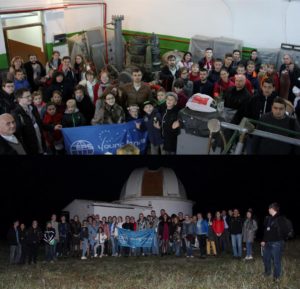
 In the middle of autumn, Lviv Young Minds Section both with the Faculty of Physics of the Ivan Franko National University of Lviv organized a science communication event “Day and night physics”. Weather conditions forced us to split this event into two parts: “Night physics: astronomical observatory” (October 17, 2017) and “Day physics: Sunday of experiments” (October 22, 2017). We were close to our main purpose – popularization and promotion of science within an audience of different age – than ever.
“Night Physics” is four similar night excursions to the suburban observation station of the Astronomical Observatory of the Ivan Franko National University of Lviv, where participants were briefed on history of the observatory and its equipment, history of astronomical studies in Ukraine, modern world’s largest telescopes, most significant discoveries in the last 15 years. The participants were told about the structure of the telescope and observed the night sky (Saturn and Pleiades using the telescope and famous constellations). Each excursion lasted for more than 1 hour. We rented a bus for four groups of visitors. Participation was free of charge and with prior registration. The total number of visitors is aroud 120.
“Day Physics” is an event rich in entertaining experiments and demonstrations. Therefore, visitors could see what physicists are doing in the daytime and try themselves as researchers. The concept of the event was quite simple: 6 areas of physics, respectively, 6 laboratories, parallel sessions, 4 hours. Participation was free of charge and without prior registration.
Laboratory of Radioengineering prepared experiments involving electric spark, a Hall sensor, lasers, electromagnetic induction, investigation of different signals using a computer and a USB oscilloscope.
Laboratory of Low-Temperature Physics demonstrated nanostructures, experiments with liquid nitrogen and helium, the superconductor levitation.
Laboratory of Optics demonstrated diffraction, interference, geometric optics, polarization, luminescence, holography.
Laboratory of Metal Physics showed the Brownian motion, series of experiments concerning pressure changes, how to synthesize a magnetic fluid and control it using electromagnets.
In the Laboratory of Astrophysics, participants made their own star chart, learned how to use it.
Also, the Laboratories of Theoretical Physics and Optics have prepared interactive parts. Theoreticians helped participants to make the pendulum of Capitza, a cloud in a bottle, the easiest analogue of a non-Newtonian and magnetic fluid, etc. Opticians concentrated on different aspects of luminescence, game of light and colorful shadows.
The series of experiments were repeated like sessions in a cinema, according to the schedule. Long demonstrations in the Laboratory of Low-Temperature Physics were repeated 2 times. Interactive parts continued without interruptions. All other laboratories repeated 30-min. demonstrations 5 times.
The total number of visitors is around 350.
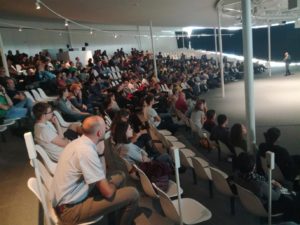 The EPFL Young Minds section expanded with success during the last year. As planned, monthly seminars were organised under the label ‘Pizza Physics Beer’ (PPB). We noted a steady number of participants ranging from 30-45 during the past semester. We are now 8 students fully invested in the organisation of the PPB meetings and other events.
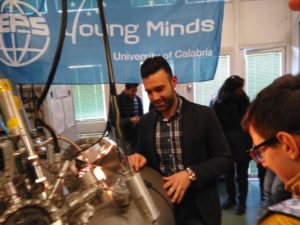 This activity has comprised both visits of students to University of Calabria, Department of Physics and, moreover, visits of members of the YM section to secondary schools.
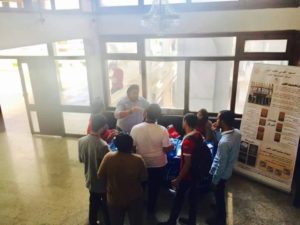 Faculty of Engineering, Cairo University, organizes Annual Job Forum to connect between the faculty student and the Market. EPS CYMS joined the event titled “Biomedical Engineering Careers in the Market” that was held in the conference room of the faculty of Engineering, Cairo University, May 2016 with an attendance of more than 250 students of biomedical engineering from all over Egypt.
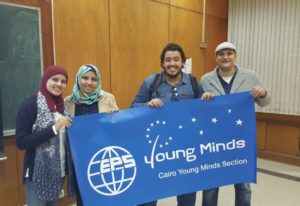 Since it’s an essential knowledge for students who work in one research group, also for us the section members, the day started with a speech about (How to work in a team). The main idea was connecting Science with industries by calling one of related industrial companies in field of optics; Scope Optics Company. Its owner and representative, Dr. M. Abd Elazeem was invited to give a speech and he responded pleasantly. The last seminar was given by Lecturer Yusuf and he is also the section treasurer talking about his work which helps central retinal impairment patients to get the overall visual scene.
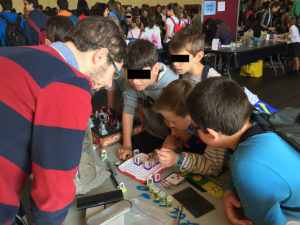 In order to explain some optical phenomena as the reflexion, the refraction, diffraction, the scattering, the absorption and the emission of the light we made an OPTICAL WORKSHOP. In these workshops, we visited schools of different academic levels and we did easy and fun experiments to prove to children and to young people that the science is closer to them. We tried to show them that the science is important in our daily life and that everybody can study science. We usually participate in workshops organized by the University Jaume I. In this year, we participated in the following University’s workshops: 1) “Practica a l’UJI”, 2) “FIRUJICIENCIA 2017”, 3) “Colònies Cientìfiques a L’UJI 2017” and 4) “Connect amb la Ciència de la Universitat Jaume I”. It should be noted that our activities were successful, considering that were attended more than 500 pupils. On the other hand, we can say that in the most cases, the optical workshops have become the first contact of society with the science and with our university. Finally, we believe that these workshops help us to promote our outreach activities and the University Jaume I. Moreover, we have shown to the children and teenagers that to study science can be a good option.
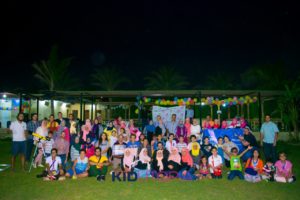 EPS Cairo young minds section contributed to an inspiring event for innovative kids called “Kidutopia”. About fifty kids (from five to sixteen years old) attended this event which is the first event that combines sciences, sports and educational consultations for kids in Egypt. This event had many non-governmental organizations that cooperated with us to give these kids an outreaching in different activities. The YM Cairo section organized and implemented simple experiments relating to various motivating physical phenomenon through enjoyable activates. These experiments included optical illusion, water lens and light refraction in addition to some simple optical activities using a laser kit game. This event had a positive impact on the kids through the participation of the children in performing these experiments. Moreover, this event was very exciting to the section members as it served an extremely important part of the community: Kids
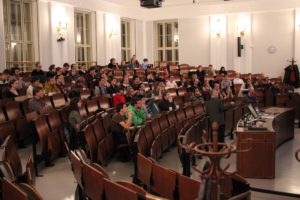 The Students Meeting at the Start of the Semester took place for the fourth time and is beginning to have the status of an established event at the Faculty of Nuclear Sciences and Physical Engineering (FNSPE). This was mirrored by the high attendance of almost 70 people which increased again, compared to the previous semester. As usual, we invited a high-profile speaker in the Czech Republic to give a talk at our university. This time, because of the recent Nobel Prize in the field, we invited Prof. Jiri Podolsky from Charles University to speak about gravitational waves which is the main topic of his research.
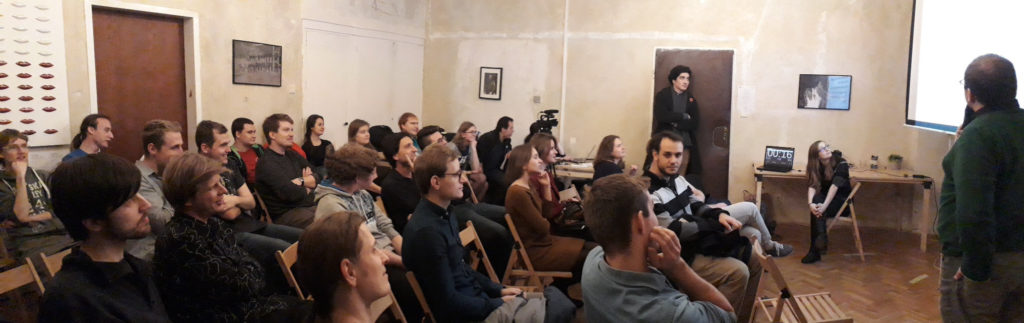 During the winter semester of 2017, a follow-up of the previous semester’s Physics Café was organised as one of the Prague EPS Young Minds events. This time, the aim of the Physics Café project was to further enhance the achievements gained during the first volume of Physics Café i.e. to provide a platform for informal meetings of university students and (senior) scientists and people from academia, with a strong emphasis on informality, and to promote physics and physics related scientific fields among the students.